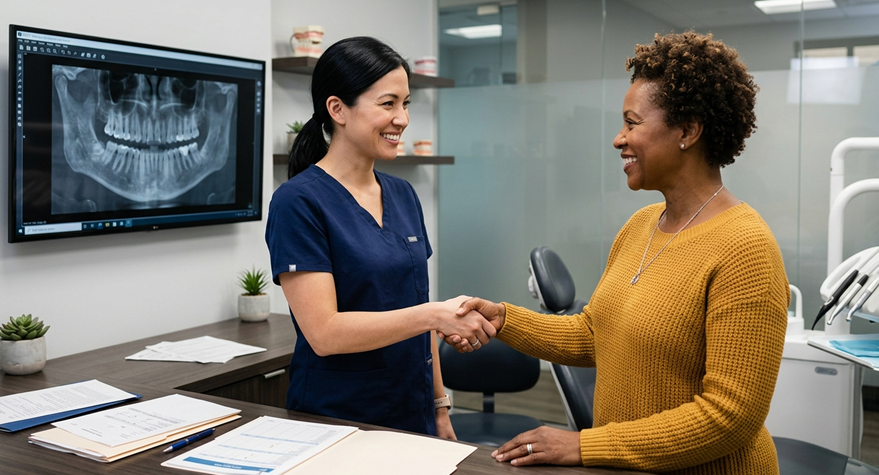
Dental Implants in East Orange, NJ

Cost, Candidacy & Long-Term Value​

For patients across Belleville, Nutley, Kearny, Newark, and the greater Essex County area of New Jersey, dental implants represent a significant but increasingly accessible investment in long-term oral health. The upfront cost is higher than other tooth replacement options – that is simply the reality. But the question of whether implants are worth that investment requires a longer view than the initial price tag suggests.
This guide is written for patients weighing the decision carefully. It covers who makes the best candidate, how implants compare to dentures and bridges over a realistic ownership period, what the process looks like from start to finish, and how patients in the East Orange area can make implant treatment financially manageable.

The Hidden Cost of Leaving a Tooth Unreplaced

Before comparing the cost of implants to other options, it is important to understand what happens when a missing tooth is left unreplaced – because inaction carries its own escalating costs, both oral health and financial.

When a tooth is lost, the jawbone beneath it begins to resorb. The bone that previously surrounded the tooth root no longer receives the stimulation it needs to maintain its density and volume, and the body gradually reclaims it. This process begins within months of tooth loss and continues progressively for years.

The downstream consequences include:
A dental implant placed at the time of tooth loss – or as soon as clinically appropriate thereafter – prevents all of these consequences. Viewed this way, an implant is not just a restorative choice. It is a preventive investment in the health of everything surrounding the missing tooth.

Comparing the Lifetime Cost of Implants vs Alternatives

The most meaningful cost comparison between tooth replacement options is not the upfront price. It is the total cost of ownership over a realistic lifespan.

Removable dentures: A full or partial denture has the lowest initial cost. However, because dentures rest on top of the gum and do not anchor into the jawbone, they do not prevent bone resorption. As the bone changes shape, the fit of the denture changes – requiring relining every few years and full replacement every seven to ten years. Adhesive, cleaning solutions, and follow-up adjustments add further ongoing cost. Over a twenty-year period, the cumulative cost of denture maintenance frequently approaches the cost of an implant placed once.

Fixed dental bridges: A bridge typically lasts ten to fifteen years before requiring replacement. Each cycle of replacement involves new crown preparations on the anchor teeth. Over two to three replacement cycles spanning twenty to thirty years, the total cost of a bridge often exceeds the cost of an implant – alongside the additional clinical cost of altered adjacent teeth and ongoing bone loss beneath the gap.

Dental implants: The implant post, once fully integrated, can last a lifetime with proper care. The crown attached to the implant may require replacement after fifteen to twenty years due to normal wear. No relining, no adhesive, no impact on neighboring teeth, and active prevention of jawbone resorption throughout the patient’s life. For most suitable candidates, the long-term cost per year of reliable function is lower than that of either alternative.

Who Is a Good Candidate for Dental Implants in East Orange?

A common misconception is that implants are only suitable for a narrow subset of patients with ideal bone and perfect health. In reality, the majority of adults who have experienced tooth loss are either immediately suitable or can be made suitable with preparatory treatment.
Ideal candidacy criteria include:
Patients who have experienced significant bone loss are often still candidates following a bone grafting procedure that rebuilds the implant site before placement. Patients with controlled diabetes, cardiovascular conditions, or other managed health concerns are frequently suitable for implant treatment with appropriate care coordination.

The only reliable way to determine candidacy is a thorough clinical evaluation that includes 3D imaging – typically a cone beam CT scan – to assess exact bone volume and density at the planned site. For patients in Belleville, Nutley, Kearny, and Newark exploring whether they qualify, affordable dental implant consultations in East Orange provide exactly this assessment, giving patients a clear, personalized picture of their options before committing to any treatment.

Understanding the Full Implant Timeline

One of the factors that causes patients to hesitate about implants is the multi-month timeline. It is worth understanding that this timeline consists mostly of natural biological healing – not repeated clinical interventions.
Consultation and imaging

The process begins with a comprehensive evaluation including 3D imaging. A personalized treatment plan with a clear timeline and cost breakdown is produced at this stage.

Preparatory treatment (if needed)

Bone grafting, periodontal treatment, or tooth extraction are completed as required. Healing from bone grafting typically takes two to four months before implant placement can proceed.

Implant placement

The titanium post is placed surgically under local anesthesia. The procedure itself typically takes under an hour for a single implant. A temporary restoration ensures the patient is not left without a tooth during the healing phase.

Osseointegration

The implant integrates with the jawbone over approximately three to six months. This is passive biological healing - patients live normally and attend only a follow-up check-in during this period.

Final crown placement

Once integration is confirmed, the permanent abutment and shade-matched crown are placed. The restoration is complete and immediately fully functional.

Making Dental Implants Financially Accessible

Several practical options exist for managing the cost of dental implant treatment in New Jersey:
Third-party financing

Many dental practices in the East Orange area offer financing through third-party providers that allows the total treatment cost to be spread across monthly payments over twelve to sixty months. Some plans offer zero-interest promotional periods for patients who qualify. This makes it possible to begin treatment immediately and pay over time rather than saving the full amount upfront.

Dental insurance review

While most traditional dental insurance plans cover little or nothing for implants, this is changing. Some employer-sponsored plans and individual plans available through the NJ marketplace are beginning to include partial implant benefits under major restorative coverage. It is worth reviewing your specific Summary of Benefits carefully and contacting your insurer directly before assuming no coverage applies.

Flexible Spending Accounts (FSA) and Health Savings Accounts (HSA)

Dental implants are generally eligible expenses under both FSA and HSA accounts. If you have access to either of these accounts through your employer, using pre-tax dollars for implant treatment can reduce the effective out-of-pocket cost meaningfully.

Phased treatment planning

For patients who need multiple implants, a phased treatment approach - completing one or two implants at a time - allows the financial commitment to be spread across several months or years. A good dental team will sequence the treatment plan in a way that is both clinically appropriate and financially realistic for the patient's situation.

Taking the First Step Toward Dental Implants in East Orange

The decision to pursue dental implants is ultimately a personal one that depends on your clinical situation, budget, and priorities. What this guide can confirm is that for patients who are suitable candidates, implants consistently deliver better long-term oral health outcomes, greater function, and higher patient satisfaction than any other tooth replacement option currently available.

For patients throughout Belleville, Nutley, Kearny, and Newark, the East Orange area offers established dental practices with the imaging technology, clinical experience, and patient-focused care needed to deliver implant treatment at the current standard. The first appointment – a consultation and imaging assessment – is where the process starts and where all your questions can be answered with specifics tailored to your own oral health picture.

FAQs

The cost of a single dental implant in the East Orange and greater Newark area of New Jersey typically ranges from $3,000 to $5,500 in total, including the implant post, abutment, and crown. The range reflects variation in whether preparatory procedures such as bone grafting or extraction are required, and differences between practices in technology and overhead. A precise cost estimate is provided during the consultation after imaging is completed.
Most traditional dental insurance plans in New Jersey provide limited or no direct coverage for dental implants. However, coverage landscapes are changing, and some plans do cover portions under major restorative benefits. Review your specific plan's Summary of Benefits carefully and call your insurer to confirm exactly what is covered. Many practices also offer financing to bridge any gap between insurance coverage and the total cost.
A thorough consultation includes a clinical examination of your teeth, gums, and bite, along with 3D imaging (CBCT scan) to assess bone volume and the position of critical anatomical structures. Based on these findings, the dental team outlines a personalized treatment plan that includes the recommended approach, any preparatory procedures needed, the anticipated timeline, and a full cost breakdown. No commitment to treatment is required at the consultation stage.
Most patients return to normal daily activities - including work - within one to two days of implant placement. Physical activity and strenuous exercise should be avoided for a week or so to allow initial healing to proceed without disruption. Dietary modifications (soft foods) are recommended for the first week. Full recovery, including complete tissue healing around the implant, typically occurs within two to four weeks, after which there are no activity restrictions.

Book Your Visit with Maple Dental NJ Today

Whether you’re due for a routine exam or experiencing dental discomfort, Maple Dental in Nutley, NJ (07110) is here to help. Call us or book online to schedule your next visit with a dentist near you who truly cares.